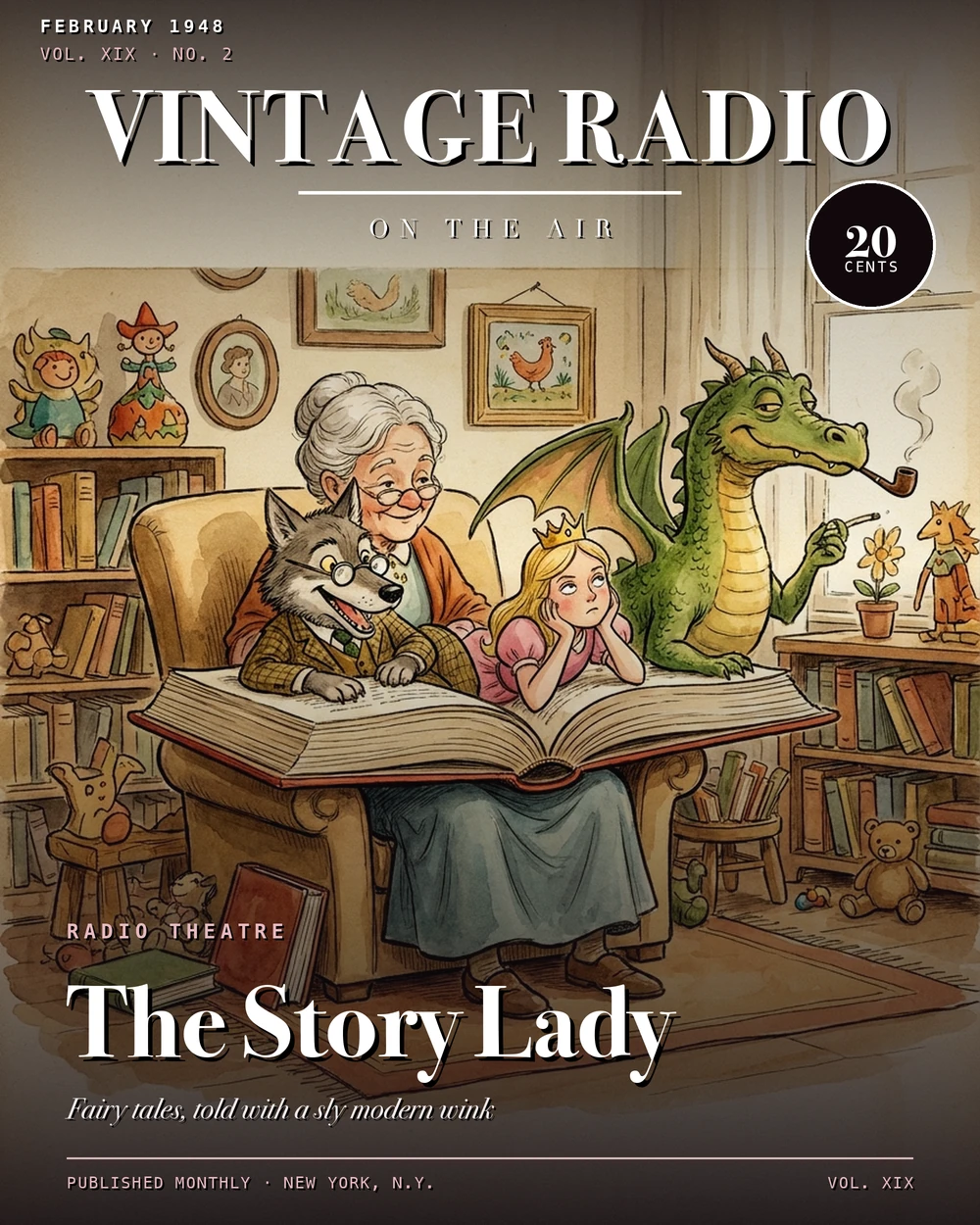
The Story Lady
Fairy Tales with a Twist
Most radio shows built their reputation on long-form drama, carefully constructed suspense, or big-name stars. The Story Lady went the other direction entirely — short, sharp, comic retellings of fairy tales and folk stories, each clocking in at roughly one minute. The format sounds almost impossibly brief, but that constraint was the whole point. There was just enough time to set up a familiar story and then detonate it with an unexpected twist, a modernized detail, or an ending that went somewhere the Brothers Grimm never intended.
The show was syndicated, meaning it traveled to stations across the country in packaged form rather than originating from a single network broadcast. One of its most notable homes was KMPC 710 AM in Los Angeles, where it became a regular feature on Gary Owens's afternoon drive show. Owens, Gerber, and other comedy-oriented voices associated with KMPC were part of the creative team that gave The Story Lady its wry, knowing sensibility. From there it spread across the dial, accumulating 217 episodes in the catalog — a substantial run for a program built around sixty-second comic bits.
The Voice Behind the Stories
The show rested almost entirely on Joan Gerber, whose narration gave the whole project its particular flavor. Gerber was born in Detroit on July 29, 1935, and spent decades working in radio, cartoons, and live-action production. Contemporaries described her as possessing a "golden throat" and a "splendid singing voice," and those qualities translated into something specific on The Story Lady: a soft-spoken, gentle delivery that made the satirical punches land harder by contrast. She sounded every bit like a proper storyteller — right up until the moment the story stopped being proper.
Outside The Story Lady, Gerber built one of the more quietly impressive voiceover careers of her era. She voiced Freddy the Flute on H.R. Pufnstuf, which she counted among her personal favorites, played Mrs. Beakley on DuckTales, and contributed character voices to the early seasons of Sesame Street. Her range ran from warm and maternal to sharp and comedic, a combination that served The Story Lady especially well. Gerber kept working into the early 2000s and died on August 22, 2011.
The Droll Announcer
Byron Kane — born Byron Harold Kaplan on May 9, 1923, in St. Albans, Vermont — was the show's announcer, and his role was more than just introductory. He reliably delivered the last word at the end of each story, sometimes a punch line, sometimes a teaser, always a button on whatever Gerber had just set up. Multiple sources describe him as "the droll announcer," and that adjective fits: Kane's timing and tone were the dry counterpoint to Gerber's sweeter narration.
Kane had a wide radio career before and alongside The Story Lady. He appeared in Favorite Story, Gunsmoke, Suspense, and Yours Truly, Johnny Dollar, and later served as associate producer on Blake Edwards's television series Peter Gunn from 1958 to 1961. He also did substantial voice work throughout his career. Kane died in Los Angeles on April 10, 1984. The pairing of Gerber and Kane — one warm and smooth, one dry and deadpan — gave The Story Lady a comedic rhythm that carried across the full run of the series.
What the Stories Actually Did
The source material was the standard canon of Western fairy tales and folk stories: Rumpelstiltskin, The Emperor's New Clothes, The Frog Prince, Tom Thumb, The Princess and the Pea, The Tortoise and the Hare, The Brave Little Tailor. These were stories the audience already knew by heart, and that familiarity was the engine. The show worked by establishing the recognizable setup and then steering away from it — through slight modernizations, altered plot details, or endings that swapped the expected moral for something more comic or deflating.
A title like The Frog and the Grilled Cheese Sandwich tells you most of what you need to know about the approach. The show wasn't interested in faithful retellings or even gentle updates; it wanted the joke that came from the collision between the ancient and the anachronistic. And because the spots ran only about a minute each, the joke had to land fast. There was no room for setup that didn't pay off. The brevity forced a kind of comic discipline that a longer format might have let slide.
Despite the fairy tale subject matter, the series wasn't aimed at children. The satirical and comic alterations pushed the material toward an adult sensibility, which made sense given its original context as a feature on afternoon drive radio. These were stories that assumed the audience knew the originals well enough to enjoy watching them get dismantled.
The Music and the Format
The show's theme was Mozart's Aria of Papageno from The Magic Flute — a light, birdlike melody that fit the tone exactly. It signaled something playful and slightly absurdist before a word had been spoken. As a piece of scene-setting, it was economical and effective: listeners knew immediately they weren't in for straight drama.
The format itself was genuinely unusual for syndicated radio. Most syndicated programming in the era aimed for a quarter-hour or half-hour slot that stations could schedule as a standalone program. The Story Lady was built around spots, not episodes in the traditional sense — short comic interjections that could be dropped into a host's show rather than occupying their own block. That made it flexible and portable, which likely contributed to its reach across the country. The KMPC connection to Gary Owens's afternoon show illustrates how it worked in practice: the spots were part of the texture of an on-air personality's program, not a separate destination.
After Radio
The Story Lady didn't stay purely in audio. An animated version of the series was also produced, with Gerber and Kane reprising their roles, and 141 episodes of that animated series were later made available through the Roku channel store. The animated version carried the same basic concept into a visual format — familiar stories retold with comic twists — and the involvement of the original voice cast kept it connected to the radio original. The transition from audio to animation was relatively natural given that both performers were voice actors first, and the short-form structure adapted easily to a cartoon frame.
The radio catalog stands at 217 episodes. Given that each one ran roughly a minute, that represents a substantial volume of material compressed into a small total runtime — less than four hours of audio to account for the full run. It's a different way of thinking about a show's legacy than the hour-long drama format, but the count is what it is, and the consistency of the voice pairing across all of it gives the series more coherence than the format might suggest.